
IJC-JW-201 Japanese Kanji: Lesson 5
Complete all parts below to get credit for today's lesson. Click on the one at the top to get started.
Lesson 5 Big Idea: Why Kanji?
Let’s get started by reviewing why kanji are even part of the Japanese language to begin with. What is it that kanji do that other writing systems simply can't. This will in fact answer two
questions at the same time: why kanji are used at all, and why there isn’t just kanji -- that is, why Japanese also chooses to employ kana as well.
Complete the form below to get credit for this part of the lesson after having watched the Main Lesson lecture video above. Note: you shouldn't have to sign in to Google to complete this form.

Lesson 5 Kanji Challenge
やれやれ! Our next Kanji Challenge invites us to look at the next six-member group of the 48 Top Radicals, this time located in the 50% Category.
Remember that the goal of getting familiar and memorizing these special components is to have the advantage of recognizing more quickly the most likely meaning and/or on-yomi reading of any of the rest of the 2,136 Jouyou kanji. The next six radicals comprise the 50% Category's Group 1, which you can see go counterclockwise starting from the top of the 48 Radicals graphic below.
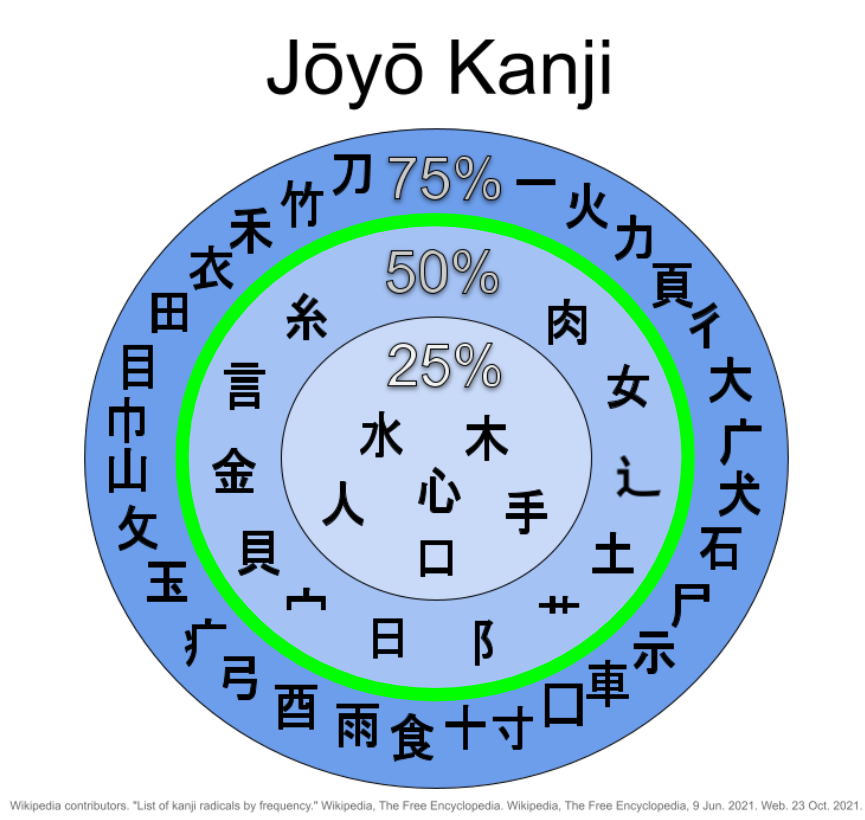
48 Top Radicals: 50% Category
The 48 Top Radicals:
50% Category Radicals (Group 1)
Meanings & Readings
糸 シ : silk, thread
言 ゲン・ゴン : say, word
金 キン・コン・ゴン : metal, gold
貝 バイ : shell, money
宀 ベン・メン : roof, crown, ウ
日 ニチ・ジツ : day, sun
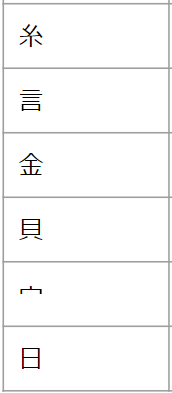
50% Category Group 1
As before when we last visited this graphic, here's what to do to complete the challenge:
❶ Search for an article or other text for a kanji that includes one of the components above inside it.
My own example below shows three kanji (highlighted) that include 糸, 貝, and 言 among their components.
” 2021年3月 - 2022年2月の営業実績では、同社の大丸ブランドの百貨店の中では最大の売上高を計上する。”
("大丸神戸店." Wikipedia: The Free Encyclopedia. Wikimedia Foundation, Inc, 8 Mar 2023, https://ja.wikipedia.org/wiki/%E5%A4%A7%E4%B8%B8%E7%A5%9E%E6%88%B8%E5%BA%97. Accessed 10 Mar 2023.)
The first one's radical it turns out is 糸 and has to do with "exploits"/"unreeling cocoons," so its radical clearly relates to the meaning of 糸 ("thread") while the 貝 component in it would do better for a story I could make up for remember the character later.
The second kanji, 貨, whose radical is 貝 ("money"), has to do with "goods" or "property" -- indeed, things that are acquired through financing. And 言 plays the radical in the third, 計, which involves "plotting," "planning," and "measurement," which can be argued involve speaking. A bonus for the third kanji is that the on-yomi is ケイ, which is really close to 言's reading of ゲン.
(Remember that these challenges only expect one example of a radical example from you.)
❷ Use Jisho.org or a similar Japanese-English dictionary to look up the kanji you found. (You can watch this tutorial if this is the first time you've ever looked up a kanji in an online dictionary before.) The goal is to uncover the relationship between the kanji and the component or radical you've discovered: either its reading or its meaning.
❸ Write down the kanji and findings regarding its radical, then upload and submit a picture of your notes using the form in the Handwriting section above for credit for this challenge. ⛄